For patients comparing stem cell therapy in Malaysia, cell quality should be explained clearly. This guide shows what we mean by COA-supported, quality-documented mesenchymal stem cells, how batch documentation is reviewed, and which questions patients can ask before treatment planning.
Best forPatients asking how MSC source, batch identity, documentation and lab standards are reviewed before clinical planning.
Documentation focusCertificate of Analysis, Certificate of Guarantee, batch records, handling notes and quality-control evidence.
Next stepSubmit your case through Clinical Intelligence Review so cell-related questions can be matched to your diagnosis and records.
What COA-supported MSCs means
COA-supported MSCs means the cell product is accompanied by documentation that helps identify and review the batch, source and quality-related information. It gives the clinical team a more structured way to discuss cell quality with patients.
What a COA does not mean
A Certificate of Analysis is not the same as a medical outcome promise. It supports product documentation and quality review. Patient suitability still depends on diagnosis, medications, risk factors, investigations and doctor-led assessment.
Why documentation matters
Stem cell therapy should not feel vague. Patients deserve a clear conversation about source, handling, batch documentation, screening, storage, transport and how these details fit into treatment planning.
Certificate Of Analysis Explained
A Certificate of Analysis is a quality-control document connected to a specific product or batch. The exact format can differ by supplier, laboratory and product type, but the purpose is the same: to provide structured information that can be reviewed before clinical use.
Batch or lot identification so the product can be linked to its documentation.
Cell identity and quality-related parameters relevant to the product type.
Screening or testing information supplied by the laboratory or manufacturer.
Storage, handling or release-related details where applicable.
A document trail that allows patients and clinicians to ask more precise questions.
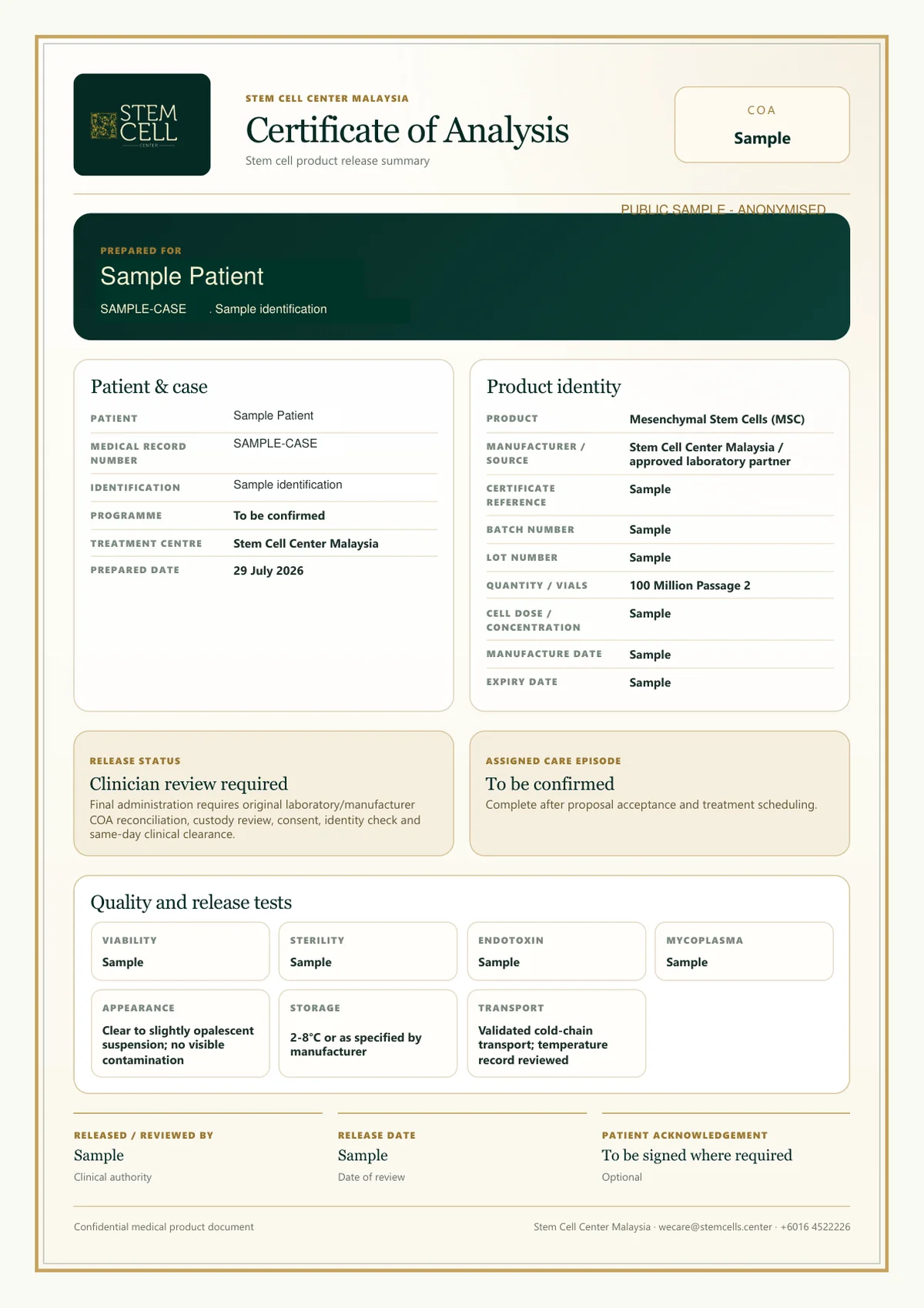
Anonymised sample
What A COA May Look Like
This sample is shown for patient education only. Personal identifiers have been removed and replaced with sample wording. Original documentation is reviewed during the clinical pathway together with batch identity, custody, consent and patient suitability.
An anonymised public sample of COA-style documentation. Actual review depends on the original laboratory/manufacturer document and the patient’s clinical context.
Certificate Of Guarantee Explained
A Certificate of Guarantee is best understood as a documentation statement connected to the product, source, supply or batch-handling process. It should be interpreted carefully. It supports confidence in the documentation pathway, but it is not a guarantee of patient response.
When patients ask about a Certificate of Guarantee, the right discussion is not only whether a certificate exists. The stronger question is what it covers, who issued it, which batch it applies to, and how it fits with the patient’s medical review.
Source
Cell origin and documentation
Patients can ask how the cells are sourced, what documentation accompanies the source, and how donor or origin-related screening is handled where applicable.
Batch
Traceability and batch review
Batch-level documentation helps the team avoid vague claims. It connects a product discussion to a specific documented lot or release pathway.
Handling
Storage and transport standards
Handling matters because cells and biologically derived products require controlled processes. Relevant storage and transport notes should be part of the clinical conversation.
Clinical fit
Patient suitability remains separate
Good documentation supports safety review, but patient suitability must still consider diagnosis, current condition, medications, infection risk, imaging, labs and recovery goals.
What patients can ask
Questions To Bring Before Treatment Planning
These questions help patients compare clinics more intelligently without being overwhelmed by technical language.
Can the clinic explain what COA-supported MSCs means in simple terms?
Can the clinical team describe the difference between cell documentation and medical suitability?
Is the documentation connected to a specific batch or product pathway?
How are storage, handling and timing considered before use?
Who reviews the documentation in relation to the patient’s diagnosis and treatment goals?
Prepare your diagnosis, medication list, recent blood tests, scans, infection history, wound photos if relevant, and previous treatment records.
During review
The clinical team can connect your medical situation with the most relevant cell-quality questions, instead of discussing documentation in isolation.
After review
If a treatment pathway is considered, documentation questions can be discussed alongside consent, preparation, follow-up and recovery planning.
Frequently Asked Questions
Is a COA the same as a treatment guarantee?
No. A COA supports product and batch documentation. Medical suitability and patient response are separate clinical matters that require doctor-led review.
Can patients ask to discuss the COA?
Yes. Patients can ask what documentation is available, what it refers to, and how it is considered in the treatment planning process.
Why does batch-level documentation matter?
Batch documentation creates a clearer trail between the product being discussed and the quality information connected to it. It helps avoid vague or unsupported statements.
Does better documentation replace medical assessment?
No. Documentation improves the quality conversation, but clinical review still has to consider the patient’s diagnosis, risks, reports, medications and goals.
Share cell quality questions, COA details, lab reports, clinic comparison notes or safety concerns before treatment planning so the clinical team can review what matters first.
Before treatment planning, patients can check our doctor-led review process, cell quality documentation, safety questions and readiness pathway in one place.
Doctor-led clinical review
Review My Case Before Treatment Planning
Send your medical summary and reports so the team can review suitability, documentation questions and the right preparation pathway before any treatment discussion.
Use this page as part of a structured decision journey: clarify the patient goal, prepare records, compare options responsibly and move into Clinical Intelligence Review when ready.
Clinical pathway visual for patient records, diagnostics, treatment planning and follow-up review at Stem Cells Center Malaysia.